BUYING GUIDES
Best Troy Iron Sights for Your Setup (Beginner to Advanced)
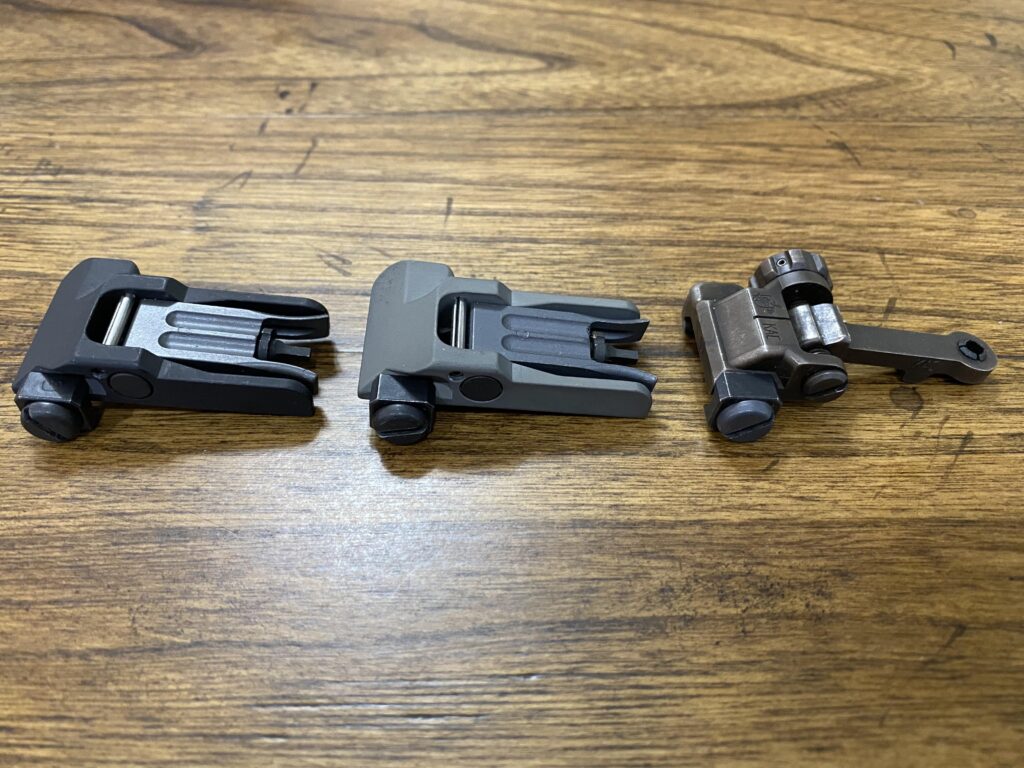
In 2026, Troy Industries continues to be a staple for professional-grade iron sights. While the market has shifted toward lighter, tool-less polymer options, Troy’s “all-metal” philosophy remains the preferred choice for shooters who need equipment that can survive heavy impact and heat.
This breakdown covers the four pillars of the Troy BattleSight ecosystem: Folding, Fixed, Micro, and Aperture Styles.
1. The Core Choices: Folding vs. Fixed
Before you select your sight picture, you must decide on the mechanical function of the unit.
Folding BattleSights (BUIS)
These are the industry standard for backup use.
-
The Mechanism: They use a cross-locking system that ensures the sight won’t collapse if you bump it. You must push a button to fold them down.
-
Profile: When folded, they sit only 0.460″ high, easily clearing the objective lens of most low-mounted optics.
-
Best For: Use with Red Dots, LPVOs, or any setup where the irons are a “Plan B.”
Fixed BattleSights
Troy Fixed Sights are essentially “one-piece” units with no moving parts (other than the adjustment dial).
-
The Mechanism: They use a streamlined, recessed crossbolt mount that is incredibly snag-free.
-
Durability: With no springs or hinges, these are the most durable iron sights in the Troy catalog.
-
Best For: Primary sighting systems or for shooters who want a constant “Lower 1/3” co-witness through their red dot.
2. Front Sight Geometry: HK vs. M4
The front tower shape is Troy’s most famous design choice.
-
HK Style (Hooded):
-
Design: A circular “globe” surrounds the post.
-
Utility: High speed. By centering the circular front hood inside the circular rear aperture, you get a “circle-in-a-circle” picture that is very intuitive for the human eye.
-
-
M4 Style (Winged):
-
Design: Uses the classic flared “ears” found on military M16/M4 rifles.
-
Utility: High precision. Shooters trained on mil-spec platforms often find this clearer for distance shooting, as there is less “metal” surrounding the target.
-
3. Rear Aperture: Round vs. Di-Optic (DOA)
The rear sight determines how your eye focuses on the front post.
4. Speciality Sizing: Standard vs. Micro
This is the most critical technical choice. Getting this wrong will make your rifle nearly impossible to zero.
-
Standard Height: These are for Standard AR-15 / M4 rifles where the top rail is flat from the receiver to the handguard. They co-witness with standard 1.5″ optic mounts.
-
Micro Sights: These are specifically for high-rail rifles (like the HK416, SIG MCX, or Robinson Arms XCR). These rifles have a taller “bore-to-rail” height, so the sights are shortened to keep your cheek weld natural.
-
Note: Never put Micro sights on a standard AR-15; they will be too low to see through properly.
-
5. Low-Light Upgrades: Tritium
Troy offers “Tritium” versions for both front and rear sights. These contain self-luminous gas inserts that glow for ~12 years.
-
Front Tritium: Highly recommended for duty or home defense. It provides a glowing “dot” that is visible in pitch-black conditions.
-
Rear Tritium: Polarizing. While it helps in the dark, some shooters find the two glowing dots in the rear distracting or “blurry” when trying to focus on the front post.
Summary Checklist for Buyers
-
Platform? AR-15 (Standard) or MCX/HK416 (Micro).
-
Primary or Backup? Primary (Fixed) or Backup (Folding).
-
Front Sight? Speed (HK) or Precision (M4).
-
Rear Sight? Traditional (Round) or Modern/Tactical (DOA).
-
Environment? Low Light (Tritium) or Range (Standard).
