COMPARISONS
Iron Sights vs Red Dot
Choosing between iron sights and a red dot (RDS) is no longer a question of “which is better,” but rather “which is my primary and which is my backup?” In 2026, the industry has shifted toward the red dot as the standard for speed and accuracy, while iron sights remain the essential “analog” fail-safe.
Here is the objective breakdown of how they compare in tactical and precision environments.
1. Speed & Target Acquisition
-
Red Dot (The Winner): An RDS is significantly faster because it operates on a single focal plane. You look at the target with both eyes open and superimpose the dot. You don’t have to “shift” your focus between the rear sight, front sight, and target.
-
Iron Sights: These require a triple focal plane alignment. Your eye must focus on the front post while the rear sight and target are slightly blurred. This transition takes more time, especially under the physiological stress of a tactical encounter.
2. Accuracy & Precision
-
Red Dot: Most modern dots are 2 MOA or smaller, meaning the aiming point covers only 2 inches of a target at 100 yards. This allows for extreme precision at distance.
-
Iron Sights: A standard front sight post is approximately 8–12 MOA wide. At 100 yards, the post can completely “swallow” a small target, making precise shot placement much more difficult than with a crisp electronic dot.
3. Reliability & Durability
-
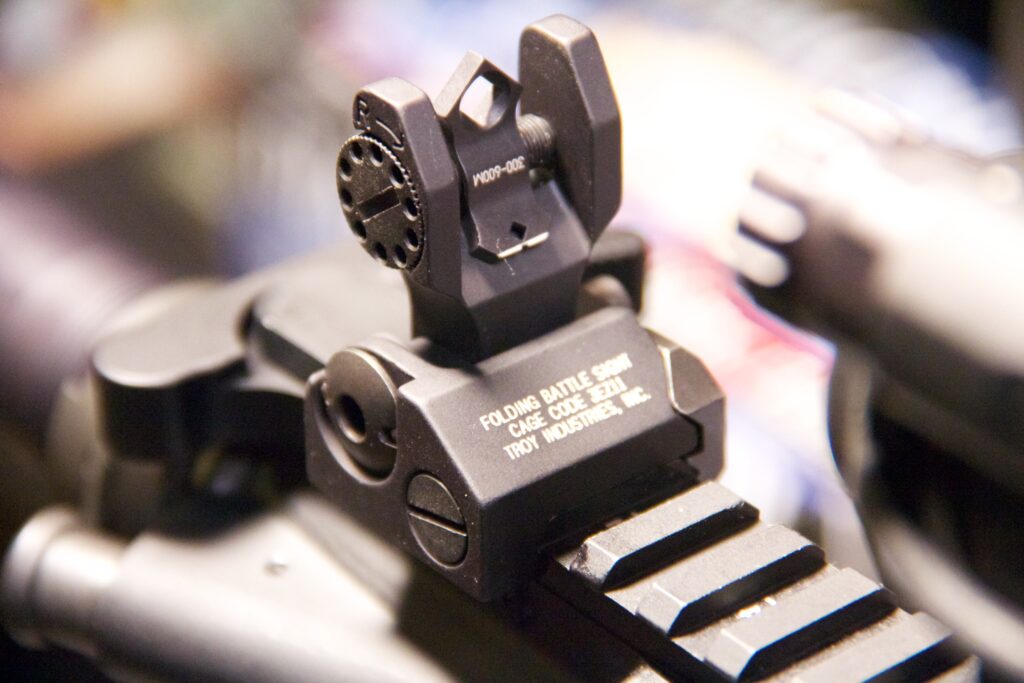
Iron Sights (The Winner): Sights like the Troy BattleSights are virtually indestructible. They have no batteries to die, no electronics to short circuit, and no glass to fog or shatter. In a long-term survival or “worst-case” scenario, they are the only sight you can truly trust.
-
Red Dot: While modern optics (like Aimpoint or Trijicon) have 50,000-hour battery lives and hardened housings, they are still electronic. They can be affected by extreme EMP, battery leakage, or catastrophic lens damage.
4. Low-Light Performance
-
Red Dot: Superior. An illuminated dot is visible in total darkness. When paired with a weapon-mounted light, it provides the clearest possible sight picture.
-
Iron Sights: Without Tritium inserts, standard iron sights are almost useless in low light, as the black posts disappear against dark targets.
Comparison at a Glance (2026 Standards)
The “Modern Professional” Solution: Co-Witnessing
In 2026, the most effective setup is not “Either/Or” but Both. By using a Co-Witness setup, you gain the benefits of both systems:
-
Primary: Use a high-quality Red Dot for 99% of your shooting (speed and precision).
-
Backup: Mount Folding Iron Sights (like the Troy BattleSights) that sit “below” the optic’s window.
-
The Fail-Safe: If the dot ever fails, you simply flip up the irons and look through the optic’s glass. You are back in the fight instantly without needing to remove the broken optic.
If you can only afford one and it’s for a “fun” range gun, go with a Red Dot. If you are building a “duty” or “serious” rifle, buy the Red Dot but never leave the shop without a quality set of Iron Sights to back it up.
