IRON SIGHTS GUIDES
Best Distance to Zero
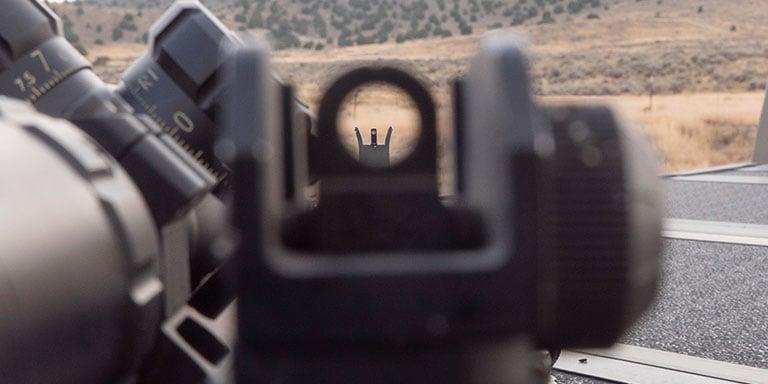
Determining the best distance to zero iron sights depends entirely on your rifle’s barrel length and your intended mission—whether you prioritize tactical speed at close range or precision at a distance.
In 2026, three “standard” zeros dominate the shooting community. Here is the breakdown of which one you should choose for your setup.
1. The 50/200 Yard Zero (The All-Rounder)
This is widely considered the best overall zero for tactical and general-purpose shooting.
-
How it works: Due to the “arc” of the bullet, a round that is zeroed at 50 yards will cross the line of sight again at approximately 200 yards.
-
The Benefit: Between 0 and 250 yards, your bullet will never rise or fall more than about 2 inches from your point of aim. This is known as “Maximum Point Blank Range.”
-
Best For: Home defense, tactical carbine courses, and general range use. You can aim “center mass” on a target at almost any practical distance and achieve a hit.
2. The 36-Yard Zero (The Tactical Flat-Shooter)
Popularized by modern combat instructors, the 36-yard zero is designed for flat trajectories at common engagement distances.
-
How it works: Zeroing at 36 yards typically provides a secondary zero around 300 yards (depending on your caliber and barrel length).
-
The Benefit: It offers a very “tight” trajectory for the first 100 yards, which is ideal for CQB (Close Quarters Battle).
-
The Trade-off: The “mid-range hump” (where the bullet is highest in its arc) is more pronounced around 150 yards compared to a 50-yard zero.
3. The 25/300 Meter Zero (The Military Standard)
This is the classic US Army/Marine Corps zero for the M4/M16 platform.
-
How it works: A 25-meter zero results in a secondary zero at 300 meters.
-
The Benefit: It allows for hits at significant distances (300m) using standard iron sights.
-
The Trade-off: The bullet arc is very high. At 150–200 meters, you may be hitting 6 to 9 inches high, which is enough to miss a small target or a headshot if you don’t “hold under.”
Comparison Table: Point of Impact (POI)
Based on a standard 16″ barrel shooting 5.56 NATO.
| Zero Distance | POI at 25 yds | POI at 100 yds | POI at 200 yds | POI at 300 yds |
| 36 Yard | -0.5″ | +2.5″ | +3.5″ | Zero |
| 50 Yard | -1.2″ | +1.5″ | Zero | -7.0″ |
| 100 Yard | -1.5″ | Zero | -3.0″ | -12.0″ |
Which Zero Should You Choose?
Choose 50 Yards if:
You want the most “forgiving” zero. You don’t want to think about “hold-overs” or “hold-unders” for any target within 200 yards. This is the gold standard for Troy BattleSights used as backups.
Choose 36 Yards if:
You are focused on tactical speed and shooting at varied distances between 25 and 300 yards. It is a favorite for those using HK-style hooded front sights for rapid acquisition.
Choose 100 Yards if:
You are building a Precision Rifle. A 100-yard zero is the most accurate because it removes most of the “arc” variables and is the standard starting point for using ballistic “drop-compensating” (BDC) reticles or dialing turrets.
Pro-Tip: Mechanical Offset (Height Over Bore)
Regardless of your zero, remember that your iron sights sit about 2.6 inches above the center of your barrel.
If you are zeroed at 50 yards but need to take a precise shot at only 5 yards (like a hostage rescue drill or a small pest), you must aim roughly 2.5 inches high to account for the physical distance between your sights and the barrel.
Which of these distances aligns best with your typical shooting range or mission profile?
