BUYING GUIDES
Troy Flip-Up Iron Sights: Complete Buyer Guide
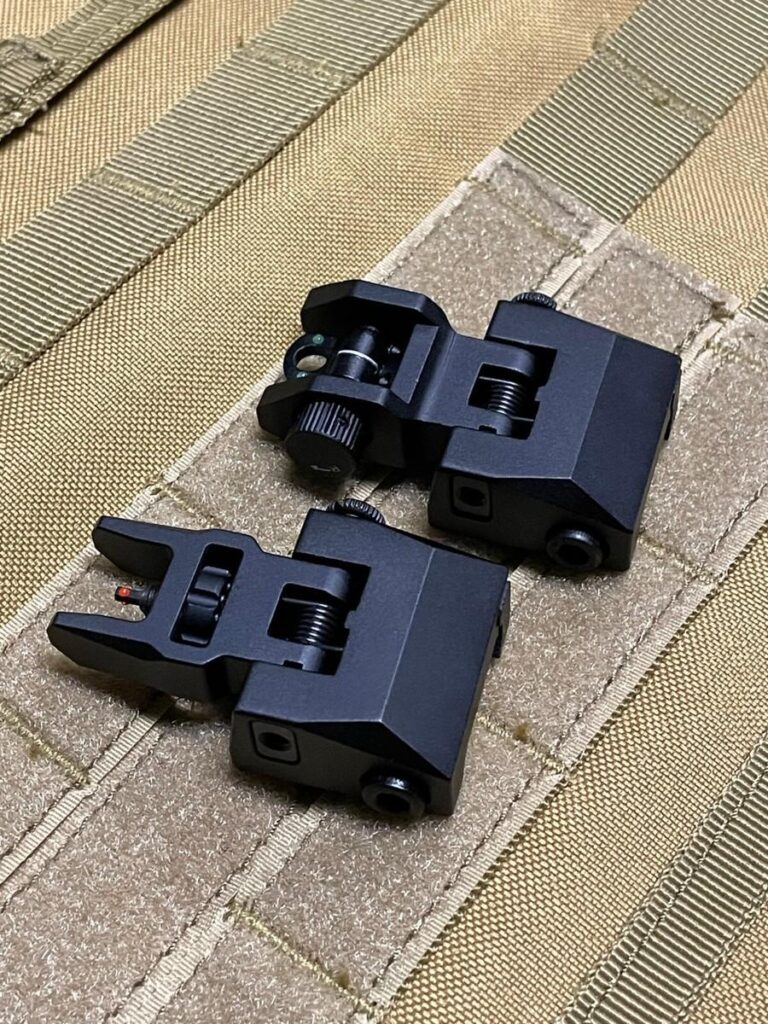
Choosing Troy Industries iron sights is a commitment to “over-built” hardware. While many modern backups are designed to be forgotten until they are needed, Troy sights are built with the assumption that they might become your primary sighting system at any moment.
This guide breaks down the technical variations to help you choose the right configuration for your rail height and shooting style.
1. The Front Sight: HK vs. M4 Style
Troy offers two distinct front-tower geometries. Your choice here fundamentally changes your sight picture.
-
HK-Style (Hooded): This uses a circular “globe” around the front post. It is designed for speed. The human eye naturally centers a circle within a circle (the rear aperture), allowing for lightning-fast alignment in high-stress tactical situations.
-
M4-Style (Standard): This uses the classic “winged” look found on military carbines. It is preferred by precision shooters who find the circular HK hood distracting or who are already accustomed to the standard A2 front sight profile.
2. The Rear Sight: Round vs. Di-Optic (DOA)
The rear aperture is where Troy innovates most. Both fold down to a slim 0.460″ profile.
-
Standard Round: The traditional choice. It features two flip-apertures (0-200m and 300-600m). It is predictable, reliable, and works seamlessly with all front sight types.
-
Di-Optic Aperture (DOA): Instead of a circle, this uses a diamond-shaped aperture. Troy claims the four points of the diamond draw the eye to the center faster than a circle.
-
Pro Tip: Pair the DOA Rear with the HK Front for the ultimate “frame-within-a-frame” tactical sight picture.
-
3. Sizing: Standard Height vs. Micro
This is the most common mistake buyers make. Do not buy based on looks; buy based on your rail height.
-
Standard Height: Designed for the AR-15 / M4 platform. These provide a standard “mil-spec” sight height that will co-witness (line up) with standard red dot mounts (Absolute or Lower 1/3).
-
Micro Sights: Designed for raised-rail platforms like the HK416, SIG MCX, or Robinson Arms XCR. Because these rifles have a higher rail-to-bore axis, standard sights would sit too high for a comfortable cheek weld.
-
Caution: If you put Micros on a standard AR-15, you will have to “scrunch” your face down painfully low to see through them, and they will not co-witness with your optics.
-
4. Enhanced Options: Tritium & Offsets
-
Tritium (Low Light): Troy offers versions with self-luminous Tritium inserts.
-
Front Tritium: Highly recommended for hunting or home defense; it helps you find the post against dark targets.
-
Rear Tritium: Polarizing. Some find the two glowing dots in the rear distracting or “blurry” when focused on the front post.
-
-
45-Degree Offsets: Ideal for rifles running a magnified scope as the primary optic. These allow you to transition to irons by simply canting the rifle 45 degrees, bypassing the need to remove your scope or flip anything up.
Summary: Which should you buy?
Technical Specifications
-
Material: Hardened aircraft aluminum with stainless steel components.
-
Adjustment: 0.5 MOA per click (Windage).
-
Mounting: Standard Picatinny (Mil-Std 1913).
-
Finish: Mil-Spec Hardcoat Anodizing.
