
SETUP & OPTIMIZATION
Accuracy Tips
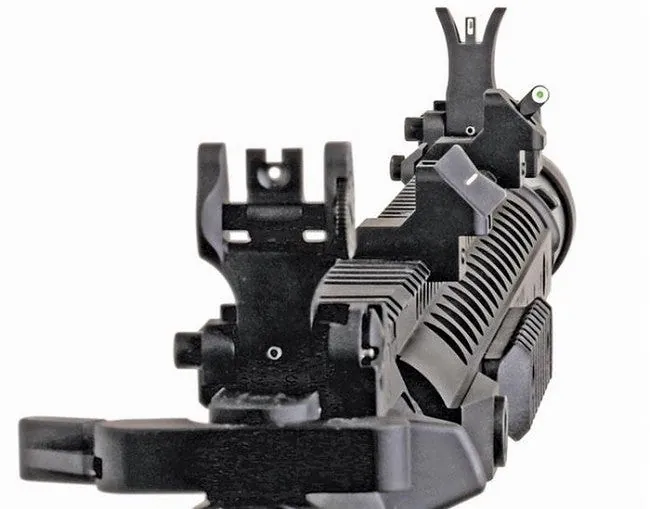
Achieving high-level accuracy with iron sights is a discipline of consistency. While modern optics offer “speed,” a master of iron sights can achieve equivalent precision by focusing on the relationship between the front post and the rear aperture.
To maximize your accuracy in 2026, focus on these five core pillars.
1. The “Hard Focus” Rule
The most common mistake is trying to look at the target and the sights at the same time.
-
The Technique: Your eye can only focus on one plane at a time. For maximum precision, you must have a hard focus on the front sight post.
-
The Result: The front post should be razor-sharp, while the rear aperture and the target will (and should) appear slightly blurry. If the target is clear, your sights are not properly aligned.
2. Perfecting Sight Alignment vs. Sight Picture
There is a critical difference between these two concepts:
-
Sight Alignment: This is the relationship between the front and rear sights. They must be perfectly centered (equal light on both sides of the post) and level across the top. Alignment is more important than the sight picture.
-
Sight Picture: This is how your aligned sights sit on the target. If your alignment is perfect but your picture is slightly off, you’ll still get a hit. If your picture is perfect but your alignment is off, you will miss.
3. Natural Point of Aim (NPA)
Accuracy is often sabotaged by “muscling” the gun toward the target.
-
The Test: Get into your shooting position and align your sights on the target. Close your eyes, take a deep breath, exhale, and open your eyes.
-
The Fix: If your sights have drifted away from the target, your body is naturally fighting your stance. Instead of moving your arms, adjust your feet and hips until the gun naturally points at the target when your muscles are relaxed.
4. Advanced Trigger Discipline: The “Surprise Break”
Precision is lost the moment you “anticipate” the shot and jerk the trigger.
-
The Technique: Apply steady, increasing pressure to the trigger. You should reach a point where the shot “surprises” you.
-
Follow-Through: Do not release the trigger immediately after the shot. Hold it to the rear for a split second. This ensures that the bullet has fully exited the barrel before any of your mechanical movements can disturb the rifle’s position.
5. Managing the “Wobble Zone”
Even the best shooters have a slight arc of movement.
-
The Mistake: Trying to “snap” the trigger the exact second the post crosses the center of the target. This almost always leads to a jerked trigger.
-
The Fix: Accept the movement. As long as your “wobble” is centered on your point of aim and you maintain a smooth trigger squeeze, the bullet will land within that zone.
Comparison: Tactical vs. Precision Accuracy
Feature |
Tactical Accuracy (Speed) |
Precision Accuracy (Groups) |
Focus |
Soft focus (Focus on target) |
Hard focus (Focus on front post) |
Aperture |
Large (Ghost Ring) |
Small (Fine peep) |
Sight Picture |
Center Mass |
Six O’Clock Hold (Lollipop) |
Stance |
Aggressive Isosceles |
Prone or Benchrested |
Pro-Tip for 2026: If you find yourself struggling with a blurry front post, check for glare. Professional-grade sights like Troy BattleSights feature serrated rear ramps to kill light reflections, but if you’re using older gear, a quick hit of “sight black” or a matte marker on the front post can instantly sharpen your focus.
